Sunday, 18 November 2012

Working on my fashion drawings and how I can make them look more interesting.

Here is a drawing that I spent quite abit of time on, I spent in all about an hour on this drawing. Firstly I stained the paper witth tea to make it look old/antique. I started off by draing a simple jacket and dress, I was aming to make them look like 18th century clothing but as I added the shadows they began to look modern. I was experimenting with what i could do with time and how i can make my drawings more intesting by putting them on differnt backgrounds such as the tea stained. I was also thinking about doing some fashion drawings on music sheets.
 

 Experimenting with time.

10 minute drawing.
 
Drawing over trhe top of a collage of material and magazines.


Quick 5 minute drawings.
 

These were quick 10 second drawings. 


Friday, 16 November 2012

Thursday, 15 November 2012

BA (Honours) Creative Art Practice Sheffield Hallam

At a glance

Prepare for a career as an artist or practitioner in the creative industries on a course led by professional artists. You have access to well-equipped facilities that allow you to experiment with everything from printmaking to digital technologies. And there are opportunities to gain work experience through placements and public exhibitions.
Key points• Benefit from the advice of professional artists.
• Experiment with a range of media using our well-equipped workshops.
• Develop your professional knowledge alongside theory and studio time.
• Develop a professional portfolio of completed and exhibited work.
What is creative art practice?Art is a subject that forms relationships with many different areas of knowledge such as making technologies and media (for example painting, sculpture, photography, video and performance), research practices and the showcasing of work (for example exhibiting).
Critically engaged with the world, fine art asks questions without a need to provide answers.

This course

Engage with all aspects of making and contemporary debate on this rich and demanding course. You explore traditional methods of making visual arts and are supported and encouraged to engage with new ideas and theories.
This course is ideal for you if you have an independent mind, a deep interest in skills-based art-making, and you’re working to develop a strong identity in your own art practice.
Exploring traditional and contemporary art making processes, you gain skills in 2D and 3D art forms ranging from painting and illustration to casting.
One of the key aspects of the course is the creative freedom you have to work in a range of practice areas. You can take advantage of a range of modern and well-equipped facilities including those for • woodworking • metalworking • printmaking • photography • the latest digital technologies.
You develop your understanding of the relationship between the process of making and the context of showing by exhibiting your work.
The course has a simple structure with three modules a year. These are developed at each level, offering increasing levels of challenge as the course progresses.
The studio module asks that you spend the majority of your time devoted to making and developing work in our dedicated studios, in specific locations or in the workshops.
The art context module focuses on art context and theory, culminating in a short dissertation, seminar or placement report in the third year.
The professional art practice module supports and develops your professional skills to help you operate within the cultural industries.
You learn from a teaching team who are artists that exhibit nationally and internationally. They support you as you develop the confidence and skills to express yourself and to communicate your ideas.
We run a guest speaker programme and give you opportunities to exhibit your work. You also have the chance to gain professional experience in the wider cultural arts sector through internships, professional practice and mentoring schemes in galleries, such as S1 Artspace and Site Gallery. We also have strong links with regional and international arts organisations, such as the Venice Biennale and Tate.
Key areas of studyStudy focuses around the three areas of • studio • art context • professional art practice.

http://www.dontpaniconline.com/magazine/radar/andrew-logan-alternative-miss-world

 
If the regular Miss World is all breast-enhanced pageant queen careerists, thenAndrew Logan's Alternative brings innovation, fun and democracy to the fore. It is the everywoman (and man) contest with a focus on style, dignity and imagination. Emily Hobbs visited Andrew Logan's studio to talk to him about last minute preparations for the 2009 event.
In just under two weeks’ time, the next Alternative Miss World will be crowned at the Roundhouse in Camden and the collective dreams of frustrated pageant queens everywhere will be realised. For Alternative Miss World is a competition for everyman - housewife, teacher, taxman and vicar; whether gay or straight; whether animal, vegetable, or mineral, each has a shot at the title. Previous winners have included a 75 year old Russian woman – (hobbies: smoking, drinking and dancing), and a robot.
 
The Pater Familias of the Alternative Miss World event, and general hostess with the most-ess, is the sculptor and artist Andrew Logan whose mission, he declares, is "to give enjoyment and pleasure to others through quirky, humorous and extravagant mementoes." And boy, does he deliver on that mission. There is no memento bigger or more extravagant than the Alternative Miss World legacy. Since the first show in an old jigsaw factory in Hackney in 1972, it has grown into an event with an international reputation.
When asked why he started hosting the Alternative Miss World event Logan replies simply, “I love throwing parties”. He calls it a "surreal art event for all-round family entertainment". While it may be accurate to describe the event as ‘alternative’, it is not niche or exclusive, nor does it have an agenda or mandate other than to show-off and have a bloody good time.
The inclusive spirit of Alternative Miss World means it attracts all types of contestants. “My sister has entered every one," says Logan. “My brother’s done a few. I have a friend who entered the first one in 1972 and is doing it again for the second time this year. At the last one in 2004 we had Norman Rosenthal from the Royal Academy – he’d wanted to do it for years.”
The running order is loosely based on a beauty contest with the usual categories of daywear, swimwear and eveningwear with what Logan calls the "oh-so-important interview" (“What I really want is world peace…”). But rather than measuring the contestants on their vital statistics and where they are on the fake-tan Richter scale of orange, the whole thing is judged on just three elements: poise, personality and originality.
Aside from this liberal approach to scoring, it’s hard to outline any more detailed criteria for judging the contestants because until the curtain rises on the night, no one present – judge or audience member – knows what to expect.
 
“All I know about this year’s show is that Miss Donna Maria – the maypole queen of the UK – will be there with her troupe”, says Logan. “There will be a maypole there too and a performance based around the Mayday ritual and the rite of Spring.”
“That’s the joy of not knowing”, he says. “On the evening I’m as surprised as everybody else because there are no rehearsals. It’s important we don’t do any so they [the contestants] literally just arrive. The stage is already set, and they just walk on and do their thing.”
 
“The reigning Alternative Miss World is a man who called himself ‘Miss Secret Sounds of Sunbird Rising'”, says Logan. “For his eveningwear he had on this dress with a big cage with live birds in it and he sang falsetto – the most amazing song in this extraordinary voice. The night he won, there were a lot of very theatrical women on the judging panel; people like Pat Quinn and Amanda Barrie. So it can be thrown by who’s judging and what they’re looking for”
The judges are all selected from a trusted circle of people who are involved in Logan’s life in various ways. “Sometimes I’ll get a phone call from an agent saying that a particular celebrity is interested in judging’, says Logan, “but I hate all that. I prefer it to be people I know. So this year we have Richard O’Brien, my great friend Zandra Rhodes and we also have Betty Mackintosh, who has been my bookkeeper and PA for almost 30 years. And Julian Clary, who hosted the last event, has agreed to come back this year as a judge.”
 
In his civilian incarnation as a sculptor, Logan takes great interest and care in creating all the Alternative Crown Jewels and winner’s thrones himself. Each event has a theme. The previous five were Water, Earth, Air, Fire and Void. This year combines them all under the umbrella of ‘Elements’. Preparations for AMW 2009 only began in earnest in September and were halted for a three-month winter hiatus in India. As we talk there are two assistants – fashion and textiles students – beavering away outside, sewing sequins and stitching fake fur trim onto the winner’s gown.
 
“Each time I do and Alternative Miss World, I say ‘never again’”, laughs Logan. Presumably it was the same story after 2004’s event, so what changed his mind? “The film”, he says. Ah yes, the film. During our interview I have been all too keenly aware of the camera lens trained on us. It follows Logan everywhere, throughout the preparations, documenting every detail down to the smallest rhinestone. What began as a much smaller project, with the intention of recording the 2004 Alternative Miss World party, has become a five-year investigation into the history of AMW as it relates to Logan’s work as an artist.
It will begin with the 2004 Alternative Miss World event and follow Logan over the five successive years, culminating in the AMW 2009. “I had to put on another one”, explains Logan, “otherwise there would have been no ending for the film!”.
 
The finished movie is slated for release in September this year and will do the rounds at the festivals. If you want a spoiler for the ending before that, then get down to the Roundhouse on 2 May and find out who the next Alternative Miss World will be.
 
The Alternative Miss World 2009 event takes place at The Roundhouse, Camden

Wednesday, 14 November 2012

http://alternativemissworld.co.uk/#/history/amw1972

EXPECT glitter, glamour, razzle, dazzle and all that jazz at The Roundhouse in London on May 2: Artist Andrew Logan returns with his Alternative Miss World contest and it promises to be a flamboyant affair.
"One of the unique points of this event is anything goes - it's everyone's kind of party," explains Logan, who launched the beauty contest in 1972 inviting hardcore exhibitionists to showcase their talents and compete for the coveted Alternative Miss World crown.
Promised "unexpected celebrity appearances" and "dancing girls", as well as "semi-naked boys" and "video art", this year the judging panel will be headed up by fashion heavyweights Celia Birtwell and Zandra Rhodes - among others - who will be judging in the categories of daywear, swimwear and eveningwear, dressing to the overall theme of the elements.


http://alternativemissworld.co.uk/#/history/amw1972

The engravings- A Rakes Progress

 A Rake's Progress - Plate 1 - The Young Heir Takes Possession Of The Miser's Effects
File:William Hogarth - A Rake's Progress - Plate 1 - The Young Heir Takes Possession Of The Miser's Effects.jpg

William Hogarth - A Rake's Progress - Plate 2 - Surrounded By Artists And Professors
File:William Hogarth - A Rake's Progress - Plate 2 - Surrounded By Artists And Professors.jpg

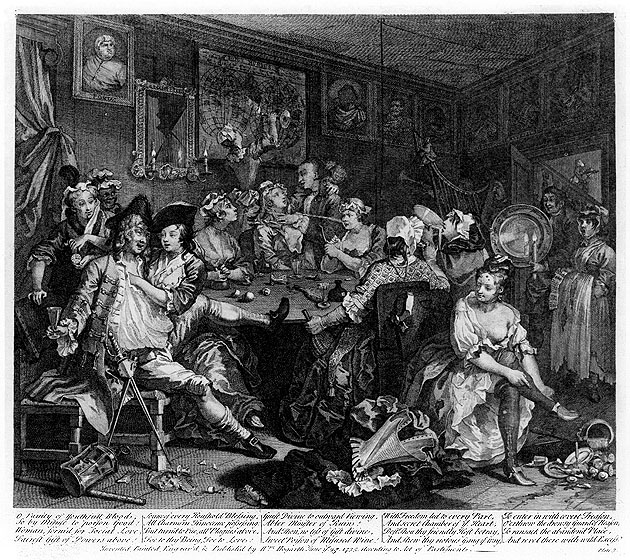
A Rake's Progress - Plate 3 - The Tavern Scene
File:William Hogarth - A Rake's Progress - Plate 3 - The Tavern Scene.jpg

William Hogarth - A Rake's Progress - Plate 4 - Arrested For Debt
File:William Hogarth - A Rake's Progress - Plate 4 - Arrested For Debt.jpg

A Rake's Progress - Plate 5 - Married To An Old Maid

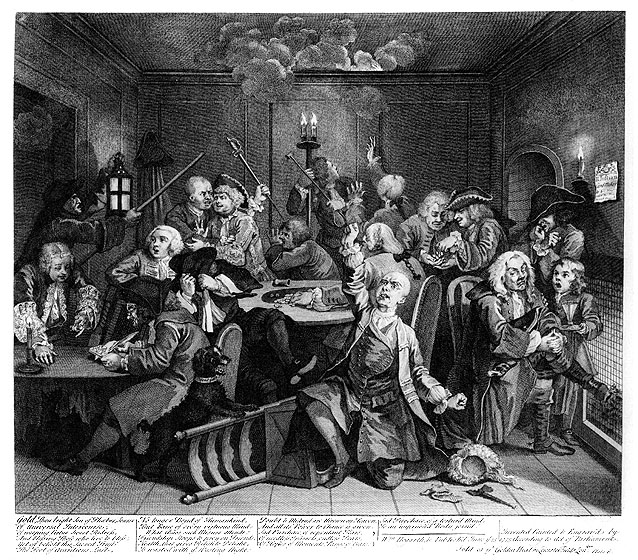
William Hogarth - A Rake's Progress - Plate 6 - Scene In A Gaming House
File:William Hogarth - A Rake's Progress - Plate 6 - Scene In A Gaming House.jpg

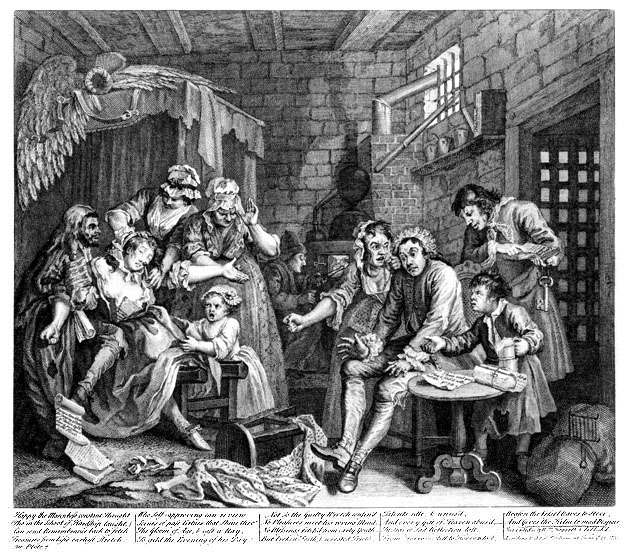
A Rake's Progress - Plate 7 - The Prison Scene
File:William Hogarth - A Rake's Progress - Plate 7 - The Prison Scene.jpg

A Rake's Progress - Plate 8 - In The Madhouse
File:William Hogarth - A Rake's Progress - Plate 8 - In The Madhouse.jpg

William Hogarth's A Rakes Progress


A Rake's Progress

 
A Rake's Progress is a series of eight paintings by 18th century English artist William Hogarth. The canvases were produced in 1732–33, then engraved and published in print form in 1735. The series shows the decline and fall of Tom Rakewell, the spendthrift son and heir of a rich merchant, who comes to London, wastes all his money on luxurious living, prostitution and gambling, and as a consequence is imprisoned in the Fleet Prison and ultimately Bethlem Hospitll, or Bedlam. The original paintings are currently in the collection of the Soane Museum in London.
The filmmaker Alan Parker has described the works as an ancestor to the storyboard.


Paintings

William Hogarth 021.jpgIn the first painting, Tom has come into his fortune on the death of his miserly father. While the servants mourn, he is being measured for new clothes. He is also rejecting the hand of his pregnant fiancée, Sarah Young, whom he had promised to marry (she is holding his ring and her mother is holding his love letters). He will pay her off, but it is clear that she still loves him.
William Hogarth 022.jpgIn the second painting, Tom is at his morning levée in London, attended by musicians and other hangers-on all dressed in expensive costumes. Surrounding Tom from left to right: a music master at a harpsichord, who was supposed to represent George Frideric Handel; a fencing master; a quarterstaff instructor; a dancing master with a violin; a landscape gardener Charles Bridgeman; an ex-soldier offering to be a bodyguard; a bugler of a fox hunt club. At lower right is a jockey with a silver trophy. The quarterstaff instructor looks disapprovingly on both the fencing and dancing masters. Both masters appear to be in the "French" style, which was a subject Hogarth loathed.
William Hogarth 027.jpgThe third painting depicts a wild party or orgy underway at a brothel. The whores are stealing the drunken Tom's watch. On the floor is a night watchman's staff and lantern. The scene takes place at the Rose Tavern, a famous brothel in Covent Garden. The prostitutes have black spots on their faces to cover syphilitic sores.
William Hogarth 026.jpgIn the fourth, he narrowly escapes arrest for debt by Welsh bailiffs (as signified by the leeks, a Welsh emblem, in their hats) as he travels in a sedan chair to a party at St. James's Palace to celebrate Queen Caroline's birthday on Saint David's Day (Saint David is the patron saint of Wales). On this occasion he is saved by the intervention of Sarah Young, the girl he had earlier rejected; she is apparently a dealer in millinery. In comic relief, a man filling a street lantern spills the oil on Tom's head. This is a sly reference to how blessings on a person were accompanied by oil poured on the head. In this case the "blessing" being the "saving" of Tom by Sarah, although Rakewell, being a rake, will not take the moral lesson to heart. In the engraved version, lighting flashes in the sky and a young pickpocket has just emptied Tom's pocket. The painting, however, shows the young thief stealing Tom's cane and has no lightning.
William Hogarth 023.jpgIn the fifth, Tom attempts to salvage his fortune by marrying a rich but aged and ugly old maid at St Marylebone. In the background Sarah arrives holding their child while her indignant mother struggles with a guest.
William Hogarth 024.jpgThe sixth painting shows Tom pleading for the assistance of the Almighty in a gambling den at Soho's White Club after losing his "new fortune." Neither he nor the other obsessive gamblers seem to have noticed a fire breaking out behind them.
William Hogarth 018.jpgAll is lost by the seventh painting, and Tom is incarcerated in the notorious Fleet debtor's prison. He ignores the distress of both his angry new (old) wife and faithful Sarah, who cannot help him this time. Both the beer-boy and the jailer demand money from him. Tom begins to go mad, as indicated by both a telescope for celestial observation poking out of the barred window and an alchemy experiment in the background. Beside Tom is a rejected play; another inmate is writing a pamphlet on how to solve the National debt. Above the bed at right is an apparatus for wings, which is more clearly seen in the engraved version at the left.
William Hogarth 019.jpgFinally insane and violent, in the eighth painting he ends his days in Bethlehem Hospital (Bedlam), London's celebrated mental asylum. Only Sarah Young is there to comfort him, but Rakewell continues to ignore her. While some of the details in these pictures may appear disturbing to modern eyes, they were commonplace in Hogarth's day. For example, the fashionably dressed women in this last painting have come to the asylum as a social occasion, to be entertained by the bizarre antics of the inmates.

"Later editions

Gavin Gordon wrote a 1935 ballet titled The Rake's Progress, based directly on Hogarth's paintings. It was choreographed by Ninette de Valois, designed by Rex Whistler, has been recorded several times, and remains in the repertoires of various ballet companies.
Igor Stravinsky's 1951 opera The Rake's Progress, with a libretto by W. H. Auden and Chester Kallman, is loosely based on the story from Hogarth's paintings. In 1961, David Hockney created his own print edition version of The Rake's Progress and has also created stage designs for the Stravinsky Opera.
The 1946 RKO film Bedlam, produced by Val Lewton and directed by Mark Robson, was inspired by A Rake's Progress. Hogarth received a writing credit for the film.
The University of New Hampshire's Department of Theatre and Dance created a collaborative stage show titled "The Rake's Progress" in 2003, which, with 17 actors and actresses, provided an intensive study of the etchings."